Location: Zoom: 828 685 7838; the video will be shown in CPE 2.222 at UT Austin
Sponsor: Department of Energy (DOE) Energy Frontier Research Center (EFRC) Materials for Water and Energy Systems (M-WET)
Title: A Light-Responsive Molecular Toolbox: Tailoring Photoswitchable Materials for Advanced Membrane and Resource Recovery Applications
Abstract
Humidity in the air is a vast water resource representing 6 times more freshwater than all rivers and lakes. This humidity can be converted to drinking water via moisture sorption-desorption, serving as a potentially decentralized, passive, and low-cost pathway to mitigate the pressing water scarcity challenge. However, the productivity and potential of this approach have been severely limited by the performance, scalability, and durability of conventional moisture sorbent materials. In this talk, I will discuss the material-level to application-level development of low-cost (<$0.1/kg of material) hydrogel-salt composites that capture record amounts of water from the air and produce liquid water even in extreme conditions like the Atacama Desert, Chile.
Firstly, I will discuss the physics-based models we developed to elucidate the key thermodynamic interactions and transport mechanisms in hydrogel-salt composites. Through comprehensive synthesis and characterization, we demonstrated that these models accurately predict the sorption performance metrics (uptake, enthalpy, and kinetics) of hydrogel-salt composites from their composition. Secondly, I will present how these insights guided the synthesis of hydrogels with the highest capability ever demonstrated of any material to capture and store water from the air (~2 kg of water/ kg of material), even in arid conditions (30% relative humidity) through an optimized swelling-based approach. Thirdly, I will discuss how our thermodynamic and transport models guided the design of a hydrogel-based atmospheric water harvesting device that was tested in the Atacama Desert, in Chile. Using these models, we tuned key design parameters to achieve ~1 L/m2/day water productivity even at ~30% relative humidity in the desert. Critically, through the demonstrated combination of low-cost, high productivity, and high material durability, we provide a path towards <$0.01/L decentralized water production from air.
I will conclude the talk by discussing other research directions in our group at the intersection of soft materials and sustainability in carbon capture, critical minerals, biomass processing, and building decarbonization.
Bio
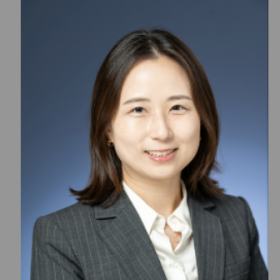
Grace Han obtained a PhD in Chemistry at MIT with Prof. Timothy Swager, focusing on organic semiconductor synthesis. After completing her PhD, she joined the Department of Materials Science and Engineering at MIT as a postdoctoral associate with Prof. Jeffrey Grossman. In 2018, Grace started her independent career in the Department of Chemistry at Brandeis University, where she was promoted to Associate Professor with tenure in 2024. Since July 2025, Grace has joined UC Santa Barbara as an Associate Professor, building an interdisciplinary research program in Materials Chemistry and Energy Sciences. Her group’s research focuses on developing molecular photoswitches and photochemistry for solar energy storage and optically-controlled recycling of polymers, catalysts, and critical minerals.Grace has been awarded honors during her independent career, including NSF CAREER Award, AFOSR Young Investigator Award, Alfred P. Sloan Fellowship, Camille Dreyfus Teacher-Scholar Award, ChemComm Emerging Investigator Lectureship, AAAS Marion Milligan Mason Award, Cram-Lehn-Pedersen Prize in Supramolecular Chemistry, and Moore Inventor Fellowship.