Location: Presented in person in EER 3.646 and via Zoom 828.685.7838.
Sponsor: Department of Energy (DOE) Energy Frontier Research Center (EFRC) Materials for Water and Energy Systems (M-WET)
Title: Understanding Facilitated Transport Membranes Using Tunable Polymer Films
Abstract
Facilitated transport membranes (FTMs) have demonstrated the ability to surpass the Robeson upper bound, making them promising candidates for industrial applications. However, the precise mechanism of facilitated transport of CO2 remains an area of active research. To address this, we have developed a versatile platform utilizing poly(ethylene glycol) diacrylate (PEGDA) networks containing pentafluorophenyl acrylate. These networks can be functionalized with Lewis bases through post-polymerization click chemistry, allowing for systematic and independent variation of carrier basicity (pKa). This modular approach ensures that the underlying copolymer characteristics, such as glass transition temperature (Tg) and crosslinking density, remain largely unaffected.
Using this platform, we have investigated the specific mechanisms for CO2 facilitation in dry and hydrated environments at varying carrier pKa. A multi-length-scale study was employed by combining macroscopic permeation experiments with microscale pulse field gradient nuclear magnetic resonance (PFG-NMR) spectroscopy to assess changes to gas diffusion at multiple length scales. This work revealed that stronger Lewis bases formed immobile carbamate complexes that increased CO2 solubility but did not contribute to CO2 flux in dry conditions. In hydrated conditions, CH4 permeability decreased at moderate water activities, possibly due to antiplasticization. Additionally, in membranes containing stronger bases, CO2 permeabilities increased at high water uptakes, likely due to the formation of bicarbonate species. Using PFG-NMR, we detected the formation of bicarbonate in hydrated membranes containing Lewis base carriers. Finally, mixed-gas experiments are planned to study the effects of carrier density and humidity on carrier saturation. This work supports existing FTM literature by validating the formation of bicarbonate species and showing how it improves both CO2 permeability and selectivity in single- and mixed-gas experiments.
Bio
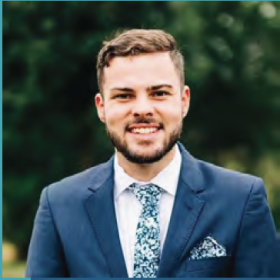
Ryan Johnson is a PhD candidate in Chemical Engineering at the University of Florida working under Prof. Joshua Moon. Previously, he earned his undergraduate degree in chemical engineering at Texas A&M. At UF, his PhD research has focused on studying the role of polymer chemistry on gas transport for CO2 separations. Specifically, he has worked on understanding the role of carrier group chemistry and concentration in facilitated transport membranes.